Pallet wrap and pallet wrapping machines
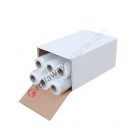
The range of pallet wrap and pallet wrapping machines contains all the professional solutions for practical and safe packaging by ensuring suitable fastening of goods during storage and transportation. In fact, the different items make it possible to wrap up the goods on the pallet where they are placed and, by securing them to the pallet, unintended movements during transport that could cause damage to the goods are prevented. They also protect the items from dust, moisture and other external agents.
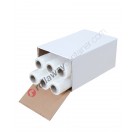
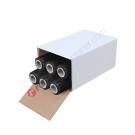
Pallet wrap is available in various colors. The transparent version allows quick identification of the packages and immediate reading of the bar code for simplified operations during storage and handling. The white or black color that characterizes the pallet wrap ensures a high level of privacy by preventing immediate identification of the goods, while the two colors allow a distinction of the packages and, consequently, a quick identification of them.
The wide range is complete with lightweight manual or metal pallet wrap dispensers ideal for optimizing time and facilitating work in palletizing operations when the use of pallet wrap becomes frequent. Finally, machinable pallet wrap is available for handling large volumes of packaging.
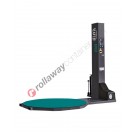
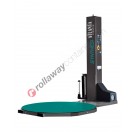
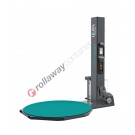
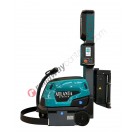
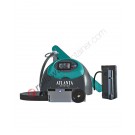
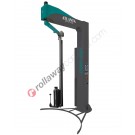
Pallet wrapping machines are the indispensable solutions for frequent packing operations. Available in a variety of models, pallet wrapping machines make it possible to meet all kinds of needs: while semiautomatic wrappers are ideal for handling numerous operations, manual models are ideal for small warehouses.
-
-
-
-
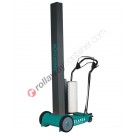
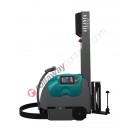
Pallet wrapper self-propelled with mast, guide wheel and Arya system
As low as€5,737.80Go to product -
What are pallet wrap and pallet wrapping machines?
Pallet wrap is a type of packaging film used to wrap and secure pallets, packages, and goods during storage and transport. Thanks to its elasticity, it secures the load to the pallet, reducing the risk of falls, unintended movement, and damage to the goods. Pallet wrapping machines, on the other hand, are devices designed to automate or simplify the process of wrapping pallets with stretch film, improving the speed, uniformity, and safety of the packaging.
What is the difference between manual and machine-grade pallet wrap?
The main difference lies in the method of use:
- Manual pallet wrap: used manually with or without a dispenser, ideal for low volumes and occasional palletizing operations.
- Machine-grade pallet wrap: designed for automatic or semi-automatic stretch wrappers and pallet wrappers, suitable for intensive and continuous use. It ensures faster packaging speeds, reduced material consumption, and resistance to pre-stretch.
What is the difference between transparent, white, and black pallet wrap?
The different colors of pallet wrap meet different operational needs:
- Transparent pallet wrap: allows for immediate identification of goods and reading of barcodes and labels.
- Black/white pallet wrap: protects the contents from external view and facilitates the identification of pallets. It makes the contents of the package anonymous, increasing privacy and security during transport and storage.
What is pre-stretch in pallet wrap and why is it important?
Pre-stretch is the system that allows the pallet wrap to be stretched before it is applied to the pallet. This operation is performed by pallet wrapping machines using special motorized rollers. The greater the pre-stretch, the greater the film savings, provided the material used is compatible with the machine’s system. Thanks to pre-stretch, the film is used more efficiently as it increases the roll’s yield, reducing consumption and packaging costs, as well as improving load stability and making the wrap more uniform. Pre-stretch systems are generally expressed as a percentage:
- 150% → 1 meter of film becomes 2.5 meters
- 220% → 1 meter becomes 3.2 meters
- 300% and above → used for intensive applications and high productivity
What thickness of pallet wrap should you choose?
The thickness of pallet wrap, measured in microns, directly affects the strength and stability of the pallet. Choosing the right thickness allows you to better protect your goods while avoiding material waste.
As a general rule:
- 10–17 microns → ideal for light pallets and stable products
- 17–23 microns → suitable for most medium-weight loads
- 23 microns or more → recommended for heavy, unstable, or sharp-edged pallets
Film that is too thin may tear during transport, while film that is excessively thick increases costs without providing any real benefits. To achieve maximum efficiency, it is important to assess the weight, shape, and stability of the load.
What is the difference between manual, semi-automatic, and self-propelled pallet wrapping machines?
The main differences concern the level of automation, productivity, and operating modes:
- Manual pallet wrapping machines: a wheeled cart that the operator manually rotates around the pallet. Ideal for small warehouses and low volumes with pallets that vary from one another, it is the simplest and most economical solution.
- Semi-automatic pallet wrapping machines: the pallet is placed on the turntable and the machine automatically performs the wrapping cycle. It is the most common solution for companies with medium to high volumes. It reduces operating time, minimizes film consumption, and improves load stability.
- Self-propelled pallet wrapping machines: the machine moves autonomously around the pallet and is ideal for very heavy, oversized, or difficult-to-handle loads. Self-propelled models are ideal for environments where a turntable cannot be used. They offer high operational flexibility and allow the machine to move and work in different areas.
What is the difference between a mechanical brake, an electromagnetic clutch, and pre-stretch?
The difference lies in how the pallet wrapping machines manage the tension of the stretch film during pallet wrapping. All three systems serve to pull the film as it is applied, but they do so with varying levels of precision, automation, and cost-effectiveness.
- Mechanical brake: This is the simplest system. The pallet wrap is braked via manual adjustment, usually with a knob. The tighter the brake is set, the more the film is pulled during wrapping. It is recommended for those seeking an economical and easy-to-use solution, especially for small volumes of work.
- Electromagnetic clutch: This is a more advanced system than the mechanical brake. Film tension is adjusted electronically via a control panel, allowing for more precise and consistent control. It is useful when you want to achieve more uniform packaging, reduce the risk of film breakage, and better adapt the tension to the type of pallet or goods being wrapped.
- Fixed pre-stretch: This is the most efficient system. Before being applied to the pallet, the pallet wrap is stretched by motorized rollers. In this way, a greater usable length is obtained from a smaller amount of film.